Showing posts with label conservation. Show all posts

Thursday, 4 February 2021

DOGS

Dogs are good. They are loyal. They are beautiful. They are humanity’s best friends. Everybody loves dogs. Dogs sure are so much popular, maybe it is because of their cute and adorable faces. Their lovable countenances and joyful behavior fill our lives with such delight, yet we often don’t realize that there's really various advantages of having a dog in one’s life. Since I was a little girl, I have always been fond of animals, especially dogs. When I was in my 4th standard, my father brought home a Doberman. As much as I can remember, he was the most beautiful dog – tall, muscular with a sleek and shiny coat. Sadly, we lost him in 2009. Now we have two Desi Dogs, namely Big Rocky and Small Rocky.

Big Rocky (Brown) and Small Rocky (Black)

The United States has the largest number of dogs with almost 89.7 million dogs. For each four individuals, there is one dog! In fact, in certain families there are more dogs than children making them a vital member of the family. In the United States alone, almost forty-three million households own at least one dog. Yes, dogs are popular in the US! Running for the second position is Brazil. Brazil has fifty-two million dogs. It is because the pet market in Brazil is one of the best on earth with a turnover of eighteen billion dollars. Although China is famous for its Yulin festival, it also has one of the largest dog populations–both pets and strays.

The Irish Wolfhound
(Picture Credit: Getty Images)

According to The American Kennel Club, there are 195 breeds of dogs with two new dog breeds ushered in 2020, namely the Barbet and the Dogo Argentino. These breeds of dogs look very different from one another. Some dogs are huge and giant like the Irish Wolfhound. They can get up to 32 to 35 inches tall at the shoulder and can weigh almost 200 pounds. But the irony here is, they are super friendly. Despite its huge size, it is seldom discovered to be damaging in the house or riotous, which is because the variety is for the most part quiet, shrewd, and reserved. Well, other dogs are small and tiny like the Chihuahuas.

A tiny chihuahua
https://www.akc.org/dog-breeds/chihuahua/

These are really small dogs especially compared to the Wolfhound. But do not fall for their size. Even though these six–9 inches’ tall dogs are known for their teensy size and big round eyes, they have this sassy and bossy personality that sure knows how to make their presence known.

Another very interesting dog breed is the Dalmatian. They are known for their white coat and black spots. One fun fact is that the Dalmatian puppies are completely white when they are born and their black spots appear only when they are four weeks old. You must already be familiar with Disney’s 101 Dalmatians, in which a villainess named Cruella De Vil, wants to buy all the Dalmatian she can discover to transform them into fur garments. What a wicked lady!

A Dalmatian puppy napping on bed
(Picture Credit: Matty  Anderson/EyeEm/Getty Images)

Now let’s talk about the most grumpy — looking dog, Yes, you guessed it right–Pugs! Pugs come under the category of ‘companion dogs’. They are a very small dog with a cute, wrinkly face. Their motto is the Latin expression "multum in parvo" (meaning a lot in a little). Pugs have acquired fame in the UK during recent years, with yearly enrollment numbers ascending from around 5.7 thousand in 2010 to 10.8 thousand in 2017. In 2019, this number dropped to 6,751.

A grumpy-looking pug
https://wallpapercave.com/funny-pug-wallpaper

If you ask me about my most favorite breed, it would be the Siberian huskies. Siberian huskies are incredible dogs. They are loyal, brave, intelligent and though little mischievous, they can be very affectionate with a human counterpart. They are one of the most wolf-like and the fourth oldest dogs in the world. They can have two different eye colors, which is something known as heterochromia. They have a unique capacity for vocalization. As most of you may have already seen videos of huskies talking, singing and even whining, there is no doubt that the husky is a particularly talkative dog and can produce a large variety of sounds.

A portrait from 'Eight Below'
https://outdoordogworld.com/husky-dog-movies/

Huskies also work as sled dogs transporting food and supplies from one place to the another. In the movie "Eight Below", starring Paul Walker, it recounts the heart-rending story of eight dogs (two Alaskan Malamutes and six Siberian Huskies) left tied outside an exploration station. Each actor-dog had help from other dogs that performed stunts and pulled sleds in the movie.


Labrador Retrievers
https://www.akc.org/dog-breeds/labrador-retriever/

Now, talking about popularity, the breed that tops the list according to the American Kennel Club, is the Labrador Retriever. The world absolutely loves Labrador retriever. These extremely friendly, active and outgoing dogs are, from Newfoundland. Originally, they procured their keep as fishers' assistants: pulling nets, getting ropes, and recovering fish from the North Atlantic. As their name already says, these dogs are pretty good at retrieving and conveying objects. Their high perseverance is a major assistance for individuals experiencing portability issues. Their affectionate nature makes them great for people who have been diagnosed with depression and other mental health issues. With their snappy reasoning nature, they can play out many undertakings such as alert against intruders and find support in crisis.

Moving over exotic huskies and Dalmatians, let's take a look at our very own Indian dogs who, accept it or not, are seldom ignored and abandoned. We have so many Indian dog breeds, each with distinct features, unique histories, and traits, but we barely know anything about them. Most of these breeds are quite unheard of let alone seen by most of the people in India. Most of you won't even believe me when I say, that more than 10 Indian dog breeds are on the brink of extinction. Some of the endangered breeds are the Himalayan Mastiff, the Asiatic/Indian Wild Dogs, and the Kashmiri Sheepdog.

The Himalayan Mastiffs
https://in.pinterest.com/arebel8/himalayan-mastiff-dogs/

The Himalayan Mastiffs, also known as Himalayan guard dogs or the Indigenous Mastiff are quiet and adoring dogs and are generally mean to satisfy their owners. They are mostly solitary dogs but they surely love the company of humans. It is said that an adult male Himalayan Mastiff is well — equipped for bringing down two wolves.

The Indian/Asiatic wild dog, also known as dholes or the red fox dog has quite a resemblance with a red fox. They mostly dwell in the deciduous, evergreen and alpine steppes. Though India has the highest number of this breed, less than 3000 fully matured Asiatic wild dogs are left in the wild. 

The Asiatic Wild dog
Picture credit: DeviantArt

The Kashmiri sheepdog or the Bakarwal Dog is an indigenous breed of Himalayan origin that are native to the higher altitudes of Jammu and Kashmir.

 The Kashmiri Sheepdog
https://medium.com/@rathor.saeed786

Unlike most dogs, these breeds are vegetarians. They are viewed as among the most extraordinary and rarest of herding dogs. They have two-fold coat, with the external coat being normal or long. They have solid height, solid legs, and a very bushy tail. The head is enormous with brilliant, adjusted eyes, hanging ears, and a wide muzzle. 

The world of dogs is just amazing. They have been to space which most of us haven't. They herd livestock, help trackers and hunters, monitor homes, and perform rescue operations. Some breeds even guide the visually impaired. Dogs are happy animals. They help to reduce stress, anxiety and a sense of loneliness. They can improve a person’s well being. They make humans happy. I don't know, dogs are just too good to be true.


Thursday, 28 January 2021

SNAKE WINE

© HADCO

Wine is a fermented juice made by harvesting, crushing, and slowly fermenting fruits like plums, watermelons, peaches, blackberries, grapefruits, pears, pineapples, etc. The whole process of winemaking is known as vinification. Wine has been a mainstream drink of humankind for quite a long time now. Our attachment to this beverage originates from the awesome taste, its nutritious properties, and not to mention its inebriating effects. The oldest winery was founded in ancient Armenia and since then wine has managed to colonize the world except for Antarctica.

I recently found out that wine can be made with much more than just fruit and that weird ingredients are being used in wine making. Out of all the unusual wine ingredients, snake definitely tops the list. Snake wine is a strong alcoholic beverage created by mixing an entire snake in rice wine or grain liquor. I mean, how awful and creepy is that. A snake? Why can’t someone just drink a regular grape wine?

Well, the beverage was first recorded to have been devoured in China during the Western Zhou dynasty. According to the customs of China, snakes are believed to have significant therapeutic and invigorative properties. They are even believed to increase masculinity and treat ailments such as farsightedness, balding, back pain, and rheumatism. Although the tradition was started hundreds of years ago (1046–771 BC), it is still pretty much alive in 21st century China, some parts of Brazil, and other South-east Asian countries such as India(Goa), Vietnam, Japan (Okinawa).

So snake wine is categorized based on whether an entire snake or some parts of a snake are used in winemaking. Steeped is the one where alcohol is set up by putting a whole snake sometimes while still alive, inside a container of rice wine or some other sort of grain liquor. It is then left to soak for months so that the essence and venom from the snake is properly infused into the liquor. Usually the snakes get some company as sometimes other smaller snakes and scorpions are added as well. Once in a while, spices or herbs such as ginseng and wolfberries are added to enhance the flavor. The other type is mixed snake wine, where a live snake is freshly killed by slicing its belly and the body liquids of the snake are mixed at once with alcohol and devoured promptly as a shot.

https://heartforanimals.com/2015/12/snake-wine-bizarre-sex-aid/

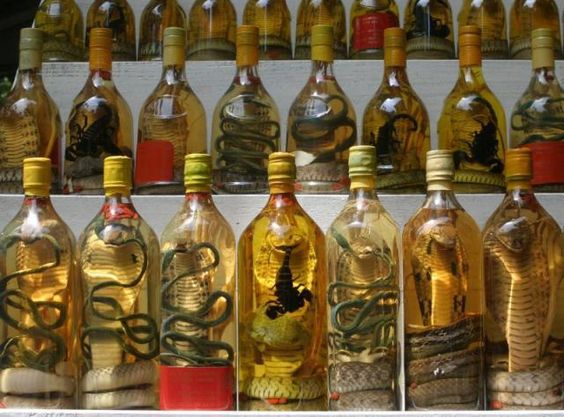
The type of snakes used for winemaking are generally non venomous such as yellow–spotted keelbacks, which are stretched and pulled to make it take the shape of a hooded cobra. In case of venomous snakes, the proteins in the venom are denatured by alcohol, rendering the effects of the venom, making it harmless. The snakes are typically stored in some alluringly formed glass containers and lined on a side of the road close to some farmer markets and tourist hotspot, where they are sold as souvenirs. Among all the places selling snake wines, the Mekong Delta in Vietnam and the outskirts of Luang Prabang in Laos are the ones that are highly involved in the business.

Snake wine being sold as souvenirs
https://in.pinterest.com/pin/144115256797165064/

 But the question is, is it really necessary?

In the name of snake wine trade, a huge  number of snakes are murdered each year, drowned and injected in liquor to make a refreshment of questionable therapeutic advantages. Isn’t the whole process just cruel and remorseless? Suffocating the animals in liquor must have caused some level of enduring even to a creature like snake. Doesn’t it sound ethically off-base to use snakes as a cash producing business? Cobras, which are the most commonly used snakes are listed as vulnerable in the IUCN list. Some people falsely believe that it has medicinal values and others like the peculiarity factor. Yet, truly, it is just barbarous and cruel. 

It also possesses some potential hazards to humans. Though it is extremely rare, snakes can stay alive in the jars for months due to a process called hibernation. In 2013, there was an incident of a woman bitten by a snake that was kept in an improperly sealed jar for the last three months. Also, if the snakes are not properly cleaned before infusing with the alcohol, there is chances of parasite growth such as salmonella.

Snake wine may certainly sound fascinating and curious to some people. But it is clearly exploitation of snakes. Do you understand the importance of snakes in maintaining an ecosystem? A decline in snake population can have unintended outcomes such as increase in rodent population, which can in turn harm rice crops. We should refrain from buying these products and any other similar products, knowing the unverified medicinal use claims and the amount of unnecessary suffering it causes to these creatures. Though the snake wine industry is quite prominent with a large part of the market dependent on tourists, it has received less attention than other dealings such as pet, meat, and skin trades. Despite the booming industry and widespread commercialization, there is still a general lack of knowledge and awareness, which makes the hype surrounding snake wine nearly non–existent.


Monday, 18 January 2021

TRY AND IMAGINE

For centuries, animals have been the subject of every conceivable experimentation. Humans might be the most superior beings on the planet, but does it mean we have the right to exploit the rest? How humans have developed to be so selfish and greedy is pathetic and saddening at the same time.
Try and imagine yourself being chained for the rest of your life. 
Imagine not being able to run under the sun and a life where you get no chance to raise a family. Ever had a thought on what happens in a slaughter house? The silent cries followed by painful death. Don't they deserve to live as much as any other living being.  Imagine the terror of the young goats who died for a piece of mutton. Thousands sacrificed in the name of religion, but isn't religion supposed to be all about love and tranquility.

What is the fate of the mother cow who just gave birth to her calves? Are they going to make a meal out of her or is she ready for another round of torture and turmoil? And what about the calves? Will they be forced to follow their mother's footsteps?

What that sinless pig must be thinking when the butcher was preparing the captive bolt ready to cut open its lifeless body? Starved for days, no food and water. They say feed withdrawal prior to slaughtering improves meat quality. 

Have you ever wondered whether the hamburger you eat and the milk you drink are a product of rape and abuse? The little bunnies, the small chicks, the tiny mice, they all have the tendency to feel pain. Humans just cannot go on comparing sizes with the extent of pain an animal suffers. Humans can’t bear even a tiny cut in their skin, then shouldn’t we take a moment and think about the animals cramped in laboratories, whose eyes are subjected to new chemicals and whose skins are scratched and tested upon every day.

What humans are building is nothing more than a stock of suffering animals. Yes, cloning mentally disturbed animals is what humans have ultimately come up with. These genetically modified animals are constantly made to suffer until humans find effective drugs to cure diseases that they themselves have been suffering from.

I ask you this one question - does significantly reducing human sufferings morally justify hurting or killing of innocent lives?

It is high time that we, as human beings stop violating the rights of other creatures and show some concern about our falling ethical standards. 
😊

Sunday, 17 January 2021

THE FINE LINE BETWEEN TIGER FASCINATION AND TIGER ABUSE


Tigers are my favorite animal. They are one of the most beautiful animals that were ever created on Earth. Whether the orange — black or the white striped, they have never failed to fascinate human beings with their beauty and charm. Tigers are greatly admired in Asia. In a country like South Korea, where tigers have now extinct, people still use tigers as symbols to signify superiority and are believed to exorcise evil spirits. 

In India, it is believed that the Hindu God and Goddesses use tiger as their 'vahana' which literally means a vehicle, but metaphorically represented as companions. In modern times, tigers have appeared in, “Winnie the pooh” stories, and in, “Calvin and Hobbs” comic strips. 

Tigers have always been a poetry weapon, fascinating poets since centuries. Like in the William Blake’s poem ‘The Tyger’, the poet talks about the imagination and skills behind creation of a magnificent creature such as tiger. Explaining human’s fascination with tigers, the renowned biologist, E. O. Wilson once wrote “We’re not just afraid of predators, we are transfixed by them, because fascination creates preparedness and preparedness, survival. In a deeply tribal sense, we love our monsters.” 

However, the United States has a disturbing tiger fascination. The country with the largest population of tiger is not India, Russia or Africa that currently occupy ancient ranges of the massive cats. It’s the United States with the largest tiger population. The private ownership of tigers in the United States is so vast and extensive that the estimated population of tigers there be higher than the total global tiger population. There are plenty of horror stories on how these big cats are kept as pets and brutally treated. Private owning of tigers include declawing and putting them in small pens and cages. Selling cubs has become a business in the United States. There are sellers who sell tigers, who then later butcher them  for parts or ranches where they are killed in hunts. Tigers in the western culture has been accounted to be used in gladiator battles and as mascots. 

Moreover, there is a blooming culture of tiger — selfie cruelty. Tigers are endlessly jabbed with metal sticks as endless stream of tourists take turns and pose with them for pictures. Tigers are man — handled, thrown from lap to lap, forcefully hugged and even sat on. These animals are forcefully tied, caged and even drugged for the sole purpose of human entertainment. Tourists or people in general need to realize that their once in a lifetime experience of being pictured with a tiger means a lifetime cruelty for the tiger.

A large fraction of tiger population is kept in captivity. These big cats are featured attractions in many circuses around the world, where they are often forcibly kept in tiny cages, their maternal bond is broken at the earliest stages of their lives, their basic social and physiological needs are denied. They are punished when disobeyed with food deprivation and are terrified with fire and sometimes these poor creatures get electrocuted. They are bound to perform against their will, to entertain the audiences. For young children, the circus is a magical place where they get to see and experience wild animals. But under the façade of harmless entertainment, patrons are unaware of what it takes to coerce these animals into performing elaborate tricks they see and the level of abuse these animals endure when the circus’ curtains come down. 

This is how people’s fascination for tiger has slowly turned into tiger abuse. Cruelty towards animals is neither a source of entertainment nor a fascination. Tigers are solitary animals. They have certain behavioral needs. They need to hunt their own prey, grow and live in the wild and enjoy their lives as much as any living being. I applaud and appreciate various Wildlife sanctuaries and Zoological parks for their substantial amount of involvement in the conservation of such animals, and their efforts in maintaining a wild habitat for them.

 Moreover, I support various non-profit organizations such as Panthera, WWF (Worldwide fund for nature), WCS (Wildlife Conservation Society) for working towards protecting these animals and for their commitment to spread the truth about life of captive tigers and other animals. But local people should not just sit and wait for only the legal organizations to work. We as public can contribute in this cause, by either donating or volunteering at organizations. We can be responsible tourists. We can write letters to lawmakers, form organizations of our own. The Government can take up steps to strengthen Wildlife Protection Acts and Laws. 

Taking a few minutes to support this worthy cause not only will help the animals, it will also make you feel proud about standing up for something so important for the society.

Small wins, Big changes