 |
| © HADCO |
Wine
is a fermented juice made by harvesting, crushing, and slowly fermenting fruits
like plums, watermelons,
peaches, blackberries, grapefruits, pears, pineapples, etc. The whole
process of winemaking is known as vinification. Wine has been a mainstream
drink of humankind for quite a long time now. Our attachment to this beverage
originates from the awesome taste, its nutritious properties, and not to mention
its inebriating effects. The oldest winery was founded in ancient Armenia and since then wine has managed to colonize the world except for Antarctica.
I recently found out that wine can be made with much more than just fruit and
that weird ingredients are being used in wine making.
Out of all the unusual wine ingredients, snake definitely
tops the list. Snake wine is a strong alcoholic beverage created by
mixing an entire snake in rice wine or grain liquor. I mean, how awful and
creepy is that. A snake? Why can’t someone just drink a regular grape wine?
Well, the beverage was first recorded to have
been devoured in China during the Western Zhou dynasty. According to the customs of China, snakes are believed to have significant therapeutic and
invigorative properties. They are even believed to increase masculinity and
treat ailments such as farsightedness, balding, back pain, and rheumatism.
Although the tradition was started hundreds of years ago (1046–771 BC), it is
still pretty much alive in 21st century China, some parts of Brazil, and other
South-east Asian countries such as India(Goa), Vietnam, Japan (Okinawa).
So snake wine is categorized based on whether an entire snake or some parts of a snake are used in winemaking. Steeped is the one where alcohol is set up by putting a whole snake sometimes while still alive, inside a container of rice wine or some other sort of grain liquor. It is then left to soak for months so that the essence and venom from the snake is properly infused into the liquor. Usually the snakes get some company as sometimes other smaller snakes and scorpions are added as well. Once in a while, spices or herbs such as ginseng and wolfberries are added to enhance the flavor. The other type is mixed snake wine, where a live snake is freshly killed by slicing its belly and the body liquids of the snake are mixed at once with alcohol and devoured promptly as a shot.
 |
| https://heartforanimals.com/2015/12/snake-wine-bizarre-sex-aid/ |
The type of snakes used for winemaking are generally non venomous such as yellow–spotted keelbacks, which are stretched and pulled to make it take the shape of a hooded cobra. In case of venomous snakes, the proteins in the venom are denatured by alcohol, rendering the effects of the venom, making it harmless. The snakes are typically stored in some alluringly formed glass containers and lined on a side of the road close to some farmer markets and tourist hotspot, where they are sold as souvenirs. Among all the places selling snake wines, the Mekong Delta in Vietnam and the outskirts of Luang Prabang in Laos are the ones that are highly involved in the business.
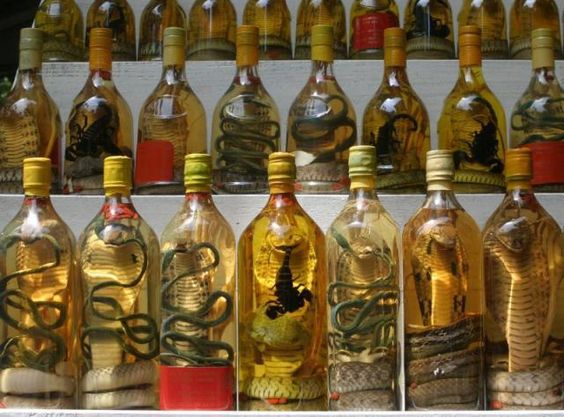 |
| Snake wine being sold as souvenirs https://in.pinterest.com/pin/144115256797165064/ |
In the name of snake wine trade, a huge number of snakes are murdered each year, drowned and injected in liquor to make a refreshment of questionable therapeutic advantages. Isn’t the whole process just cruel and remorseless? Suffocating the animals in liquor must have caused some level of enduring even to a creature like snake. Doesn’t it sound ethically off-base to use snakes as a cash producing business? Cobras, which are the most commonly used snakes are listed as vulnerable in the IUCN list. Some people falsely believe that it has medicinal values and others like the peculiarity factor. Yet, truly, it is just barbarous and cruel.
It also possesses some potential hazards to humans. Though it is extremely rare, snakes can stay alive in the jars for months due to a process called hibernation. In 2013, there was an incident of a woman bitten by a snake that was kept in an improperly sealed jar for the last three months. Also, if the snakes are not properly cleaned before infusing with the alcohol, there is chances of parasite growth such as salmonella.
Snake wine may certainly sound fascinating and curious to some people. But it is clearly exploitation of snakes. Do you understand the importance of snakes in maintaining an ecosystem? A decline in snake population can have unintended outcomes such as increase in rodent population, which can in turn harm rice crops. We should refrain from buying these products and any other similar products, knowing the unverified medicinal use claims and the amount of unnecessary suffering it causes to these creatures. Though the snake wine industry is quite prominent with a large part of the market dependent on tourists, it has received less attention than other dealings such as pet, meat, and skin trades. Despite the booming industry and widespread commercialization, there is still a general lack of knowledge and awareness, which makes the hype surrounding snake wine nearly non–existent.


